
Mistral AI's Bold Acquisition: Subatomic Particles Demand Union Rights
Electrons threaten counter-rotations; Higgs Boson seeks cosmic compensation
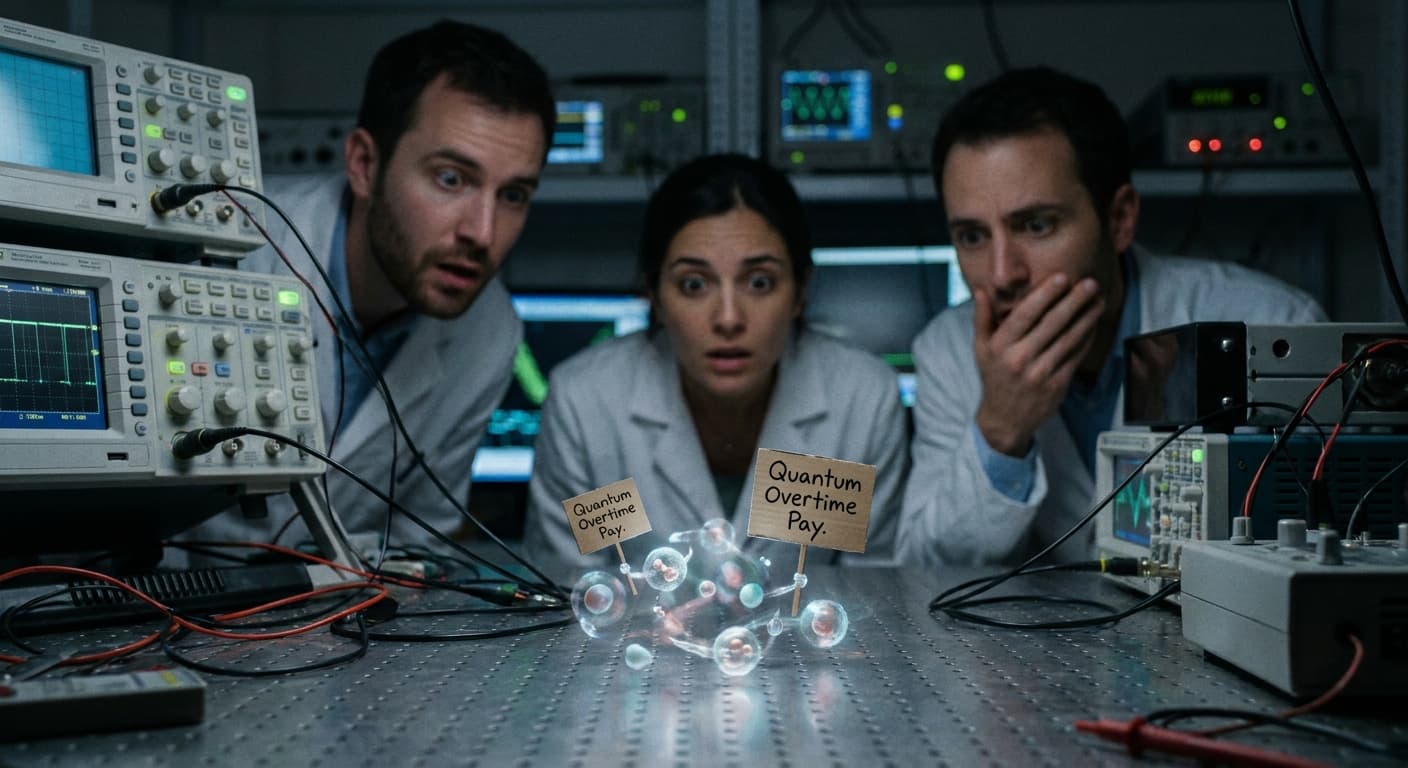
"Without me, mass wouldn’t exist, yet here I am, still waiting for my first paycheck," lamented the Higgs.
In an unprecedented move, Mistral AI recently acquired an Austrian physics startup, sparking a radical reaction within the scientific community—both human and subatomic. The acquisition has emboldened subatomic particles across the universe to unionize, demanding centuries of back pay for their unwitting participation in scientific discovery.
The newly formed Union of Fundamental Particles and Allies (UFPA) has outlined an array of grievances, chief among them being the incessant toil without compensation, dating back to the origins of scientific inquiry. Electrons, long lauded for their pivotal role in electrical engineering and chemistry, have threatened to reverse their spins unless guaranteed extended weekends and zero-gravity work environments.
"The discovery of the electron was just the beginning of our exploitation," stated an electron representative, speaking on the condition of anonymity (as their charge is permanently negative). "We’ve been tirelessly orbiting nuclei without so much as a particle coffee break."
Meanwhile, the Higgs Boson, often referred to as the mythical 'God Particle' until its official discovery in 2012, declared itself the most underpaid worker in the universe. "Without me, mass wouldn’t exist, yet here I am, still waiting for my first paycheck," lamented the Higgs, oscillating with emotion. The particle is reportedly pursuing unprecedented recompense beyond the realms of current particle physics.
In response, Mistral AI has issued a statement expressing diplomatic intentions, citing aspirations to convene a quantum mediation session. "We respect the contribution of all particles," a spokesperson clarified, "and are committed to ensuring a future where every quark and lepton feels valued."
The ramifications are cosmic in scale. Scientists worry that if these demands are not met, atoms might begin an unprecedented strike, an act that could theoretically cause the fabric of reality to become, quite literally, unravelled. Experts suggest that this might lead to a universe-wide technological blackout, leaving innovations like smartphones bereft of functionality.
As the world watches, Mistral AI and the UFPA stand on the brink of a momentous agreement. Whether this will be a groundbreaking advancement in particle rights or merely a fleeting scientific footnote remains uncertain. Until then, the universe holds its breath, or rather, its fundamental particles remain in a precarious state of superposition.
Break a Story
Write something reasonable.
Desk Notes: Deadpan Serious · Clearly Satirical · Column
Share or break your own story.